Two Dutch Girls on a Road Trip to Wiltshire

Road Trip 2017 (2) - Richmond to Chawton to Salisbury.

Good afternoon! Would you like to join me for the second part of my road trip in the South-West of England? A long time wish of my daughter...

Showing posts with label #Wetlands. Show all posts

Wednesday, 13 July 2016

The Hike 11 - Haringvliet Tour

Our Wetlands weather is acting up like the drama queen it is...Loads of rain, then sudden sunny spells and as soon as you've had a chance to dig out the sunglasses huge grey clouds blow in from the South-West again. In other words: a typical Dutch Summer.
They've even spotted a twister near Biddinghuizen yesterday!

For today's hike I remained close to home again. Saving up the cents for going to the English Peak District next month! I took a 1 1/2 hour walk along the Haringvliet, the closed off sea arm which turns into the river Nieuwe Merwede near Dordrecht.


The map shows my island - Voorne is part of three now interconnected islands Voorne, Putten and Rozenburg;  the Haringvliet is the body of water leading down from the left and the dam you can see there is the Haringvlietdam connecting Voorne to the island of Goeree-Overflakkee. You can also see that there used to be another sea arm above Voorne and Rozenburg,but that it is now almost totally filled in by artificial islands and harbours carrying industry: our famous Europort.

My hike took me from the North-West part of town (where I live) through the polders to the Haringvlietdam and then down along the water back to town.


The view from the Haringvlietdam towards the North Sea

Our seawater is not green nor blue, but greyish, due to the sediment on the bottom. It is cold, too, not reaching higher temperatures than 24 degrees in a very hot summer. Due to the weather we've been having it's barely 18 degrees now. But the quality has improved somewhat during the last twenty years, and we now regularly see seals again.


The Haringvliet with Goeree in the background


This is typical Haringvliet vegetation. We call it Kattenstaart, or cat's tail.


If you continue all along the Haringvliet, you eventually end up in Hellevoetsluis harbour, with its characteristic lighthouse.
I didn't this time, I stayed on the outskirts.

All along the path (only accessible to walkers and cyclists) there are many animals to be seen. There are the domestic sheep and horses, but more interestingly if you are in possession of a keen eye, you can spot the harrier and buzzard here, hunting for rabbits,  hares and mice and voles. Every dusk (and dawn) the deer come out to graze on the lush grass. The fox is elusive, and in the thirty years that I have lived here, I have only spotted it once!
Hence the photo underneath was taken somewhere else by my son. But I am always on the lookout for it, and for the equally elusive osprey. Today I spotted neither. The gnats did spot me though...


Photo by Wibe Koopman Photography

The nitty-gritty:
My hike took me 1 1/5 hours, and I walked 10 km.
This time I wore better pants - no chafing!
It was 18 degrees, mostly cloudy, with wind nnw 26 km/h, humidity 69%.

And that was it, folks. Hope you've enjoyed walking with me. Until next time!

Thursday, 7 July 2016

The Hike 10 - Wetlands Meadows Tour

Still prepping for my hiking holiday in a month's time...and not a lot of it - time. So I did a quick one hour training around my own wetland meadows. And to keep it interesting for myself, I took some photos for you. Want to walk along?


The starting point was the village of Nieuw-Helvoet, where I live. At the end of my street I took a right which takes you directly out of the village into the "polder". If you don't know - a polder is low lying cultivated land criss-crossed by drainage ditches called sloten. We have to do this, otherwise the land would be swamped in many places.


This is such a sloot, covered by duckweed, but it is the swans flower I want to show you. At least, that's what we call it, I don't know the latin name. When I grew up this flower was almost extinct, but due to better water pollution management it has reappeared. The yellow one is koolzaad, rapeseed, very prolific in my part of the country.

I walked towards the first crossroads and took a left, along the Ikkerseweg (love that name, as it has no meaning whatsoever) again next to a sloot absolutely framed by wild flowers.


You recognize the poppy, of course, and camomile. We pick the camomile for tea, but also to put into the dog basket, as folk lore has it that the strong smell keep fleas at bay. Sadly this does not really work 100%, so I still have to give my animals those flea drops.

The Ikkerseweg has a copse halfway, which is taken over by Giant Bear's Claw flowers(hogweed to you, I believe). I prefer our name, "berenklauw" as it scours your skin as a bear can. Huge blisters are the result.


Those monsters are taller than a tall man and they spread like a plague. Farmers try to get rid of them, but this copse is neglected.

It has a friendly gentle sister, Angelica, which also grows next to the sloot.


And the brown flower is zuring, wild sorrel.
At the end of the Ikkerseweg I took a left again, and passed a meadow with sheep and their lambs. They came running towards me, bleating, thinking I was the farmer with something tasty.


I don't know about you, but I like sheep. And now that I've read The Shepherd's Life I like them even more. A couple of years ago I had the opportunity to clip/shear one, and I'll never forget the total trust it had in me with my power tool, and the feel of the somewhat greasy wool.

Another left onto the Stormweg took me back towards Nieuw-Helvoet. I passed some youngsters, who also took an interest in me and stood there staring and blowing.
Lol, got ya!


Hate those yellow earrings, stupid things!
And that was it. Back home again.


We call this vlasbloem, flax to you.

The nitty-gritty:
I walked 14.759 steps, which comes to approx. 20 km and is totally wrong - but I did a lot of walking earlier in the day when I tried out an English assignment (with a route in hand)in Brielle. 
I think this hike must have been approx. 6 km, as it took me an hour.
It was a sunny 23 degrees, with a wsw 18 km/h wind and a humidity of 54%. 
I wore the wrong clothes, they started chafing in all the wrong spots. Another lesson learnt.

Hope you've enjoyed hiking with me, until next time!

Sunday, 5 June 2016

Climate Change And The Wetlands

English folk claim to have a patent on moaning about the weather, but we Dutchies know a thing or two (or ten) about that subject as well!
If you don't know: we live in a Delta. Our country is criss-crossed by huge rivers, streaming down on us from France/Belgium and Austria/Zwitserland/Germany.


Most of the time those rivers are placid, simply flowing on towards the sea. But when it starts raining in those neighbouring countries, and starts raining heavily, we get a wave of river water streaming into our low-lying country that poses a threat.

Now, in the olden days, our ancestors knew enough to let those rivers flow over into water meadows. Sure, they let their cows and sheep graze there, but there usually was enough time to gather those animals onto higher ground. They even made earthen hillocks (called 'terpen') especially for those times even the water meadows couldn't hold all the surplus water and would build their farmsteads there. Smart people.

But nowadays our wetlands are overcrowded and our country is built up with endless suburbs and water meadows are deemed good overflow building land instead of overflow river water land. Not so smart...Our water engineers have been warning for years, decades even, but the local planning authorities seem to have a blind spot and suffer from sudden deafness when it comes to the warnings. Money speaks louder than words.

And thus we have a problem.
This week, due to the combination of a very high ground water level (the rivers) and extremely heavy rain, some parts of Brabant (a Southern province) had to deal with water rising more than 2.5 m above normal levels, and basements and parking garages and some neighbourhoods were flooded.

And suddenly the newspapers are full of the CC words. Climate Change is here! It's not around the corner, in the future somewhere, nope, it has arrived with its suitcases packed full of wet stuff and it has planted them firmly in our living room. Hi honey, I'm home!

Of course, us being hardy no-nonsense wetlanders, used to a bit of water, they immediately gave us some good news as well. Yes, more rain, more clouds, more mist, more storms, but also some goodies we have all been pining for: we will get more exotics as well. And higher temperatures. In fact, De Volkskrant newspaper told me that our climate has shifted up as far as Paris already. We have Parisian weather - oh la la, how chique! And in a couple of years we will have shifted as far South as Lyon, saving a huge portion of us a shitload of money and a lot of driving hours as we won't have to migrate to the Ardeche in Summer any longer.
Mind you, we will need that money we will have saved for buying mosquito repellant as the tiger mosquito is invading (able of carrying Zika virus, amongst other viruses) surfing on those higher temperatures. And oh horror, will the snakes come slithering in as well? Probably.

Today, our climate showed its sunny side. For the first time in weeks we had a completely dry day and could enjoy the outdoors without a wintercoat on. It was wonderful. I sang a chanson to celebrate.


Oh well. I'll invest in some good wellies and make certain I'll have the sandbags ready. Just in case.


Thursday, 25 February 2016

The Hike - 4

Our national emblem should be the willow - not that silly lion...as if we have lions roaming our lands.
On my fourth hike towards The Hike in Northumberland, I passed many, many willows, by far the most common tree in my area. But this one, an ash, caught my eye, as it is symbolic for my wetlands delta, valiantly hanging on even when knee-deep in water.


Today was a perfect day for hiking: wind wsw 18 km/hr,2 degrees C, humidity 83%,the occasional hail shower, but mostly sunny. Well, not counting the dramatic clouds.
I set off from home and decided to get the polder stretch out of the way first, ending along the Haringvliet water with the wind at my back (see photo above).


Walking through the polder has a dynamic of its own. It's mostly battling with the wind and hoping you won't get crashed into from behind, as most polder dwellers drive like maniacs and expect you to jump into the verge.

This is typically wetlands scenery. A sloot, a straight stretch of narrow road and an endless sky.


From this distance you can really see how our local church tower and ship are divided.


Although it hailed occasionally, the bulbs along the road showed that Spring is definitely on its way! I'm a sucker for spring bulbs,  they give such a feeling of hope, that sure, sunshine will be part of our days again.


Whilst I am typing this it is hailing most fiercely, so I took my walk at the right time!
Along the way, on the Westdijk, I passed this vegetable plot, artistically draped along the dyke.


Due to the mild winter there were quite a few cabbages and sprouts still looking good.
After the Westdijk I passed from polder into dune landscape, as I was nearing the Haringvliet, the sea arm that divides my island of Voorne from the next island of Goeree-Overflakkee. The soil turns from heavy,greasy clay straight to sand and the trees change accordingly from willows and such to thorny shrub, ash and birch.


This path leads you from the last tarmac road through the dunes to the Haringvliet.


Look at that. You have your mangroves in Florida, we have our solitary ash in the wetlands. This sea arm, due to its being cut off from the sea since the Seventies and being fed by three huge rivers is sweet water, but no one has told the shells, so they are saltwater shells still, mixed with some fresh water ones.
I used to scoff at this stretch of water, being spoiled by holidays abroad and the cold green blue waters near my first home in Hampshire (GB). But I've made my peace with the Haringvliet and quite like it nowadays.


This was the best part of the hike: up the dune and down the dune, with the gently lapping water always close by on my righthand side, the occasional gull overhead and thankfully no more hail.
It took me 2 hours to get home, and 28.640 steps. 
I'm already planning the next hike, which will probably take me over to the next island by bus and back on foot.
Join me?

Wednesday, 27 May 2015

The Joy of Cycling - Wetlands Adventure No. 1 (or two...)

When you live in an entirely flat country, with only a few bumps that hardly deserve the name "hill" in the far South and the far East of your (otherwise tiny) country, you get used to wind.
And wind is precisely the thing that you either love (when you are a sailor) or loathe (when you are a cyclist).


Now there is such a thing as a sailor-cyclist (a species which takes along a folding bicycle onto their boats), and they are a curious lot, but on the whole you can divide my countrymen into two categories: the sailors and the cyclists. 
The landlubbers amongst us love to keep their feet firmly on terra firma, and only take them off to push two pedals round. Needless to say, I fall into category two.


I love my e-bike! I suffer (well, I play it down, but anyway) from arthritic knees, so cycling became a tad painful of late. But then some years ago a colleague pointed me towards e-bikes, and my horizons broadened considerably again. Not only did my school have a wizard cycle-plan, which paid half (!) of the cost of acquiring said e-bike, but it conveniently lies within cycling distance from my home - 13 kms.

My bike is a Batavus Allegro E-90, an original Dutch make, and has 8 speeds and an action radius of 130 kms (I do have the largest battery). This radius will diminish somewhat over the years (as the battery ages), but so far it is plenty for me.
Last Summer it has taken me all over the country, right up to the North and back again, in easy 80 kms a day stretches. (You can find the story on this blog, in August 2014)

The Wetlands is an ideal country for cycling. Not only is it flat, as I mentioned before, but it has an extensive cycle path network which even the biggest dummy can follow. There is a signpost on every corner and fork in the road, I'm not kidding you!
And we have a cyclists repair and aid organization, in fact we now have a couple I believe. Got yourself a flat tire and you don't want to repair it yourself? Call the number and a nice man comes and does it for you. At a price. That goes without saying.

But here it comes: using an e-bike will take the wind factor away almost entirely! All of a sudden I will cycle to work in a wind force 7, and it will still only take me 35 minutes, instead of the usual hour it used to take me with that wind. It is wonderful!
I overtake most other cyclists and even youngsters on mopeds have trouble overtaking me. The only disadvantage (as such) is that you are vulnerable to nasty accidents when your speed is 24 kms or more. But you can choose to wear a  safety helmet (I don't - I am prone to bad hair days as it is already).


The Summer holidays are approaching fast, so I am researching new cycling adventures. I'll let you know.


Sunday, 24 May 2015

Am I Blue? - The Beauty of Flowers in the Blue Spectrum.

My garden is blooming as if it is afraid there will be no tomorrow...
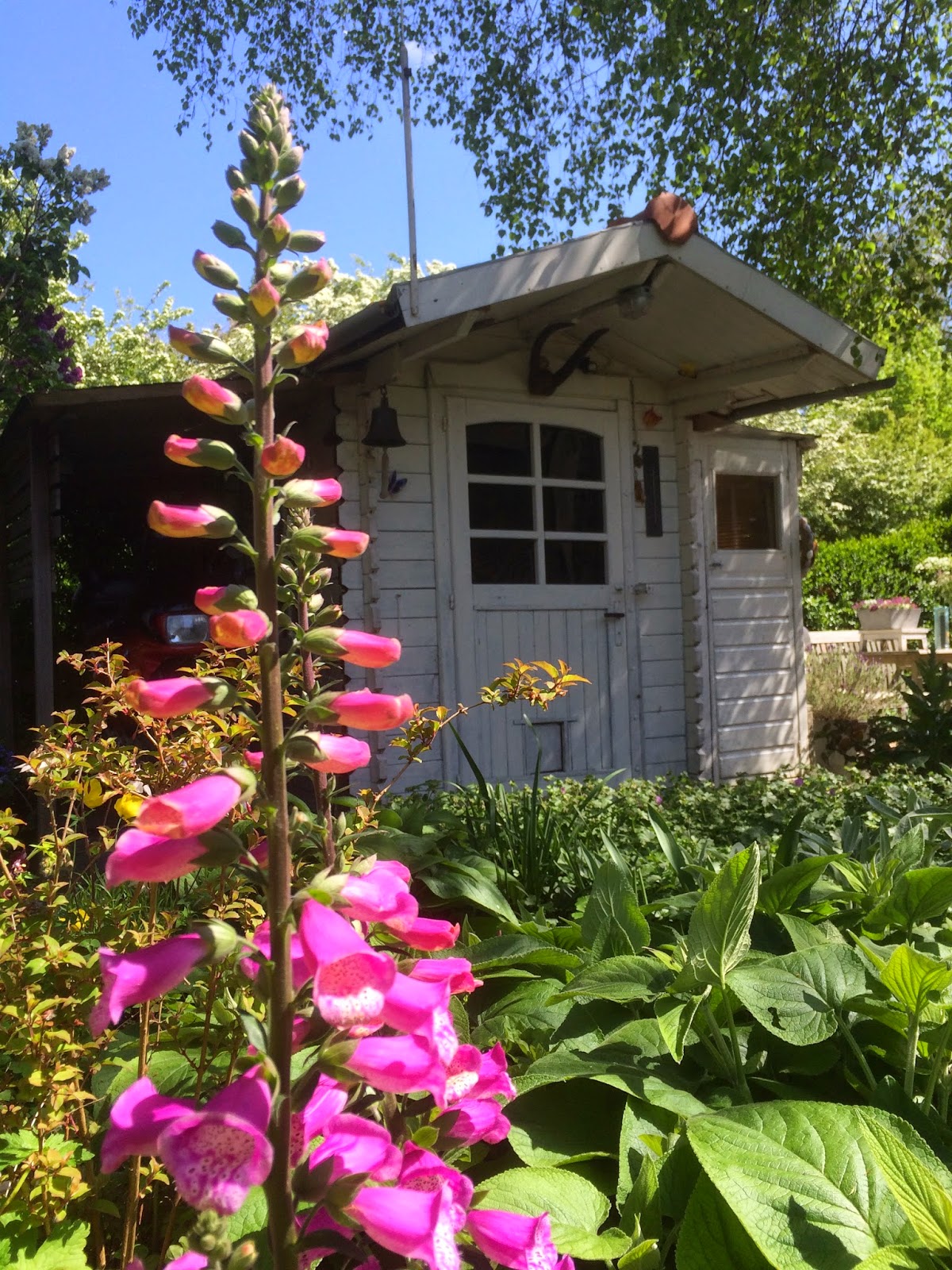
Not that I am complaining, mind! I adore sitting there with a cup of coffee very early in the morning, when my neighbourhood is still asleep, and watch the bees and bumblebees visit my poppies and digitalis. Viggo and Gina by my side; they are wise to this morning ritual.


And this morning I want to talk to you about my love of flowers in the blue spectrum.

Spring starts with white and yellow, in the Wetlands. In February/March, when our earliest bulbs start showing their colours. They are followed by blue and purple, if you ignore the fact that our tulips show every colour under the rainbow (even black!). Tulips do not count; I like them, but they are very very contrived.
In my garden white and yellow is followed by blue and purple, believe me! And there is a period, right now in fact, when the white and yellow mix with the blue and purple.

There is something about these blue and purple and pink flowers that speaks to my soul. 
Sounds a bit melodramatic, I know. 
Yellow is a cheerful colour, but flowers in the blue spectrum have an introspective quality in my opinion. It is not a coincidence that melancholy has got the label 'The Blues'. 


Here you have the ordinary Cornflower. I allow it to seed itself everywhere it likes, simply because I adore it. When I was a child that devoured books, I used to read about cornflowers in the cornfields, except in our cornfields there were none...The wild flowers were sprayed to death in the sixties and seventies. Thank Frith that nowadays they are allowed to bloom again, and well-thinking farmers even sow them in the verges! It makes for wonderful bicycle rides, I can assure you!


This 'butterfly' lavender is another favorite of mine. I always make certain I have one next to the garden table, where it scents that entire corner.


I have shown you those two photos before, but they prove my point. Lovely, lovely colours!
(By the way, if any of you know how I can upload them so that they are positioned right next to each other, please tell me how to! I cannot)

So. Blue Spectrum? Yes, please!


Saturday, 16 May 2015

Oh...go hang 'em! Hanging Baskets of the Wetland Garden.

Told you that we are enthusiastic gardeners, right? Since our borders are full to bursting, we have resorted to hanging baskets everywhere. A person must do what a person must do...


Our Willow doubles as a post, as do the other trees and chains between those trees. In this example we have combined Petunias with Phlox, Lobelia and Campanula.


Lobelia and Petunia have always been a favorite, but it is only recently that we have discovered the Campanula to be a really good basket plant. It flowers all through summer, and you can even cut it really short and it will grow bushy again and will flower again. Another wonderful characteristic of this plant is that it is resistant to the snails and slugs, who use our garden as their Summer Festival grounds.


This plant I will travel for! Streptocarpus is its name. We were given a sample a couple of years ago as an indoor plant, but it loves it outside and will flower and flower, until the first frost kills it. (This happend, even in our greenhouse...I'm ashamed to say). Ever since I try to get one for the garden every year, and as it is quite rare, I usually have to search the garden centers for it. I think that this year I will try to get it through winter indoors!


Okay, I know, technically this isn't a hanging basket, but the Dianthus combined with the Phlox and again Campanula is explosive, don't you think? It lights up this otherwise dark corner of the garden, especially when it is in the late afternoon sunlight.


The grouping of pots underneath the ghost Birch, combined with the Forest Bluebells, always gives me great joy. The red plant on the left is a Begonia with huge flowers, who is hanging its branches under its own success...they are so heavy with flowers that they almost break.

Joke! 
No, this isn't a smuggled lizard from Rome, it is a lizard from Rome who still is in Rome. Promise!
I would like it to be in my garden, though, because it would colour beautifully with my plants :-)