Two Dutch Girls on a Road Trip to Wiltshire

Road Trip 2017 (2) - Richmond to Chawton to Salisbury.

Good afternoon! Would you like to join me for the second part of my road trip in the South-West of England? A long time wish of my daughter...

Showing posts with label #Voorne. Show all posts

Thursday, 25 February 2016

The Hike - 4

Our national emblem should be the willow - not that silly lion...as if we have lions roaming our lands.
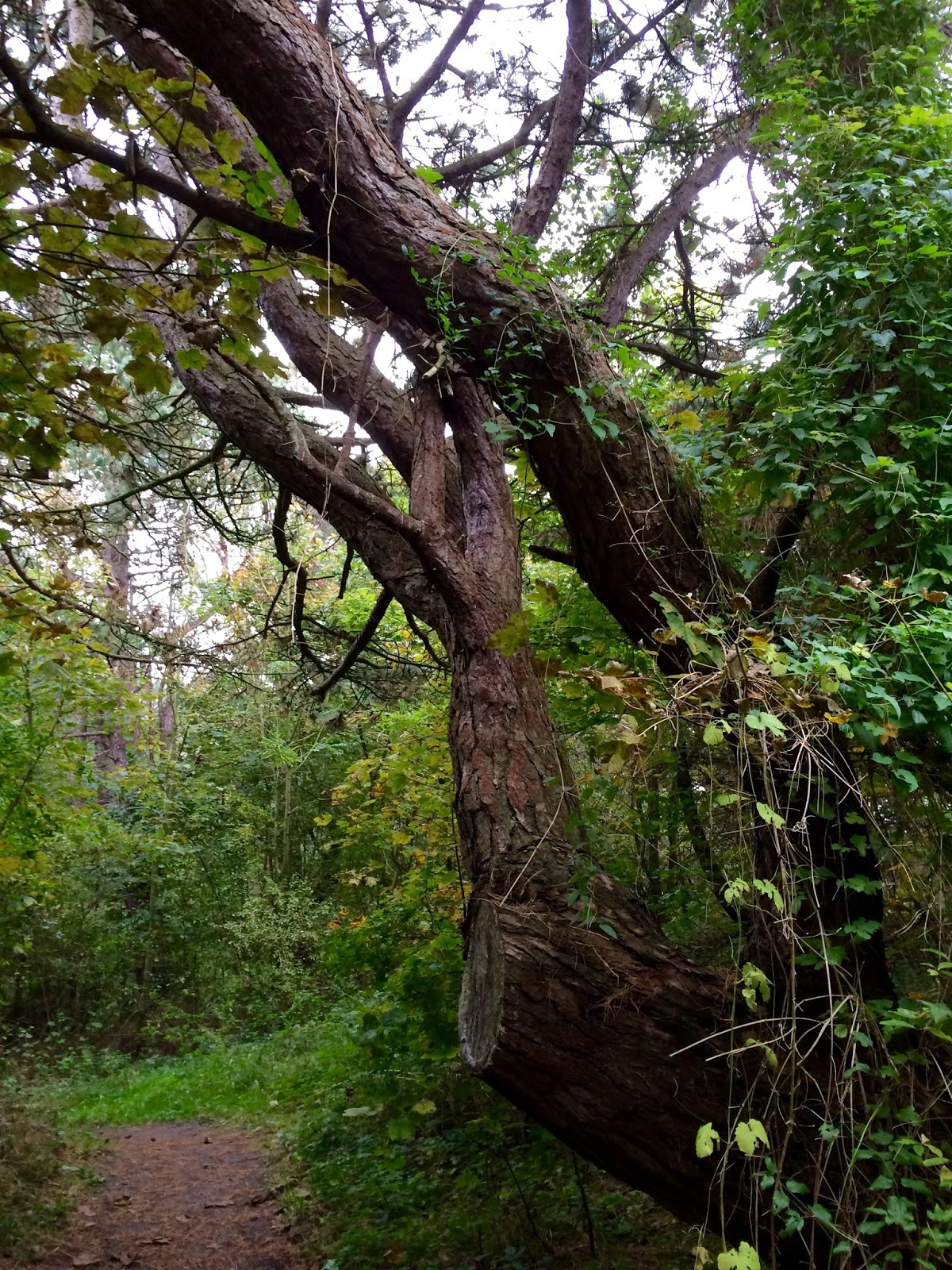
On my fourth hike towards The Hike in Northumberland, I passed many, many willows, by far the most common tree in my area. But this one, an ash, caught my eye, as it is symbolic for my wetlands delta, valiantly hanging on even when knee-deep in water.


Today was a perfect day for hiking: wind wsw 18 km/hr,2 degrees C, humidity 83%,the occasional hail shower, but mostly sunny. Well, not counting the dramatic clouds.
I set off from home and decided to get the polder stretch out of the way first, ending along the Haringvliet water with the wind at my back (see photo above).


Walking through the polder has a dynamic of its own. It's mostly battling with the wind and hoping you won't get crashed into from behind, as most polder dwellers drive like maniacs and expect you to jump into the verge.

This is typically wetlands scenery. A sloot, a straight stretch of narrow road and an endless sky.


From this distance you can really see how our local church tower and ship are divided.


Although it hailed occasionally, the bulbs along the road showed that Spring is definitely on its way! I'm a sucker for spring bulbs,  they give such a feeling of hope, that sure, sunshine will be part of our days again.


Whilst I am typing this it is hailing most fiercely, so I took my walk at the right time!
Along the way, on the Westdijk, I passed this vegetable plot, artistically draped along the dyke.


Due to the mild winter there were quite a few cabbages and sprouts still looking good.
After the Westdijk I passed from polder into dune landscape, as I was nearing the Haringvliet, the sea arm that divides my island of Voorne from the next island of Goeree-Overflakkee. The soil turns from heavy,greasy clay straight to sand and the trees change accordingly from willows and such to thorny shrub, ash and birch.


This path leads you from the last tarmac road through the dunes to the Haringvliet.


Look at that. You have your mangroves in Florida, we have our solitary ash in the wetlands. This sea arm, due to its being cut off from the sea since the Seventies and being fed by three huge rivers is sweet water, but no one has told the shells, so they are saltwater shells still, mixed with some fresh water ones.
I used to scoff at this stretch of water, being spoiled by holidays abroad and the cold green blue waters near my first home in Hampshire (GB). But I've made my peace with the Haringvliet and quite like it nowadays.


This was the best part of the hike: up the dune and down the dune, with the gently lapping water always close by on my righthand side, the occasional gull overhead and thankfully no more hail.
It took me 2 hours to get home, and 28.640 steps. 
I'm already planning the next hike, which will probably take me over to the next island by bus and back on foot.
Join me?

Thursday, 22 October 2015

The Oostvoornse Duinen - Wetlands Supreme!

For those of you who enjoy hiking (but walking is fine as well), I have a tip for you that will give you entrance to one of the oldest and most varied dune landscapes of The Netherlands:
The "Oostvoornse Duinen".


The Sea Dunes

It being our Autumn break, I went there yesterday with my regular hiking companion, who used to be 2, 3, 4...and is now 22 years old.


My son and I enjoy walking together, and this part of our island of Voorne is our favourite.
It was a typical Wetlands day: misty, damp, grey cloud cover and threatening to rain (and sure enough half-way through it did start to rain and wouldn't stop).

Oostvoorne is a small town, part of the larger municipality of Westvoorne (comprising of  Rockanje, Tinte, Brielle and Oostvoorne). To get there you take the largest motorway (which thankfully still is a two-lane) N218 and then follow the signposts to the starting point of our hike: the carpark next to the Natuurmonumenten/Zuid-Hollands Landschap Education Centre ("Bezoekerscentrum") on the Duinstraat 12a. (Adjacent to the comfortable restaurant called De Meidoorn).

Bezoekerscentrum 


The landscape has slowly evolved over the centuries. It used to be mostly sand dunes, but due to landowners planting tree plantations and acid rain it is now a very green area with lots of trees, shrubs, berry carrying shrubs and grasses and reed beds  as well as sand dunes. In order to keep the grasses in check, large areas have been fenced in (this IS The Netherlands after all) so that herds of sheep, ponies and cows can graze there in relative freedom.


Contrary to what you might think, the bottom line doesn't mean that there is no danger of meeting a wolf, but that you have to keep your dog on a leash. We don't have wolves (yet) in this part of the Wetlands.


My son and I decided to take one of the longer walks; the walk around a dune lake called Het Breede Water. (2 hours)
To get there, you have to take the path to the right next to the education centre and along the attractive lake called the Tenella Plas. Again, this being the Netherlands, there is no danger of getting lost: the paths are mostly signposted by means of coloured arrows. The Breede Water route is clockwise, signposted with a white arrow.

Tenella Plas

Tenella Plas


At first there are still some small farm houses dotted around (much sought-after to live in these days), and the typical meadows that belong to them.


Actual farming is forbidden now though, the landscape has all been given back to 'nature' (which is a laugh, really. It is as well tended as a garden!)

As soon as you have crossed the horse bridlepath, you enter a wet area, so wellingtons are a good option from October onwards. In fact, if we have a wet winter and we usually do, many of the paths are extremely muddy.

You now walk along a sandy/grassy path adjacent to one of the old pine plantations (on your left). To your right are the older dunes, with many berry carrying shrubs which attract numerous birds.


As a girl I always laughed to see the sparrows and blackbirds get drunk on the orange berries of the meidoorn.

After approximately half an hour you can view the largest dune lake, the Breede Water, on your right hand side. There is a viewpoint ("Uitzichtpunt"), from where you can spot the waterfowl whilst they cannot spot you.

Breede Water

Cormorant's Island

In Spring the Breede Water is an overcrowded place, with cormorants, swans, ducks, geese, herons (both white and blue) and spoonbills making their nests there.
Yesterday is was deserted.
I used to take my son's friends around the lake as a birthday treat (picknick), and since his birthday is in April, those boys always walked demonstratively with their noses pinched because of the stench of Cormorant's Island.

This area has so many happy memories for me! I came here with my Mum (and dogs), and then with my kids (and dogs).


To my dismay the favorite climbing tree of my children has been chopped...


Just look at this... This was 12 years ago.
As I said, you walk around the Breede Water clockwise, so at the half-way mark you enter the proper dunes.


This is the closest thing we Wetlanders have to anything slightly resembling a hill (tiny), and it used to be all SAND when I was a girl!


Breede Water from the other side, black pines in the background

I hope you will be able to follow those white arrows, for this is the (only) point where the path is a bit tricky (hard to see), and you could get lost.
Still, you are always in sight and reach of your GPS satellite, so don't you fret!

When you have almost reached the point where you started walking around the Breede Water, you again enter the forest.


The Beeches are just starting to turn


You'll know when you have not strayed when you again reach the Tenella Plas.
Do go and visit restaurant De Meidoorn before you start you car! They do lovely Dutch grub and the ambience is very friendly.

I hope you have enjoyed this route. Whenever you are near - come visit Voorne!

Google Maps pointer: type in Tenellaplas Oostvoorne.

Sunday, 6 September 2015

Are You A Beach Person?

Good morning to you!
Circumstances beyond my control (I was asked out to lunch) brought me to one of our local beaches yesterday. And even though it was your normal, typical September Wetlands beach weather (cold, damp, windy, cloudy, 14 degrees but the wind-chill factor making it feel like 12 degrees) I found myself asking myself why I don't visit the beach more often.


And no, this is NOT our beach...
This is our beach:


©Wibe Koopman Photography

Still. There were quite a lot of people kitesurfing, which I admire enormously. 
Imagine: you drive yourself to this beach (often from Germany), you gear up in a sticky sandy wetsuit, you drag this humungous kite towards the water (just take a look at that distance, won't you?), you get all those lines untangled, then the wind blows them all into a ball again and you start over, then you walk that kite into the water, you forget your board so you have to do it all again, you stand there buffeted by the waves...And when you know your stuff you're away.
As I said: I admire those people.


The ones with the kite dragging a kart - hm, not so much somehow. First, they don't get wet. Second, it's more the gear than the skill, to my un-knowing eyes. Sorry if I've offended anyone now. Not my intention, simply my opinion.

But then again, that 3rd photo is to show you the nature of our Wetlands beaches. Vast, vast, vast stretches of sand. Our tides rush in covering kilometers, no joke. Our waters are grey most of the time, sometimes a kind of blue if we get lucky. And they are always chilly to cold to downright freezing. And they are treacherous, with an undertow causing deaths every summer.

Still. They do have a certain charm.
The wildlife is wonderful. We have lots of seabirds, seals, dolphins (the smaller kind called bruinvissen), sharks (very small ones - and we play this down or otherwise all those German tourists will stay away), and a nasty little fish called a Pieterman, which has a poisoned stickle and buries itself in the sand with just the stickle sticking out (saying we play this one down is an understatement - we do not mention the Pieterman at all!) causing you agony for days. Local lore has taught me that the only relief is to pee over your foot. Quite a feat when you are hopping on one foot howling your head off. The best thing to do is to ask someone else to pee over your poor foot.


One of the good things about our local beaches is the beach restaurants. They have evolved from simple wooden shacks where you could get a bottled beer, a terrible coffee and a plate of fries (sixties/seventies) to proper (but still wooden - this is a rule) restaurants with all the mod cons and great food. Large open fires to warm yourself by (necessary in our climate), a huge range of beers to choose from, good to great food, nice ambience, often live music at the weekends, a laid-back atmosphere.


So, all in all, I told myself I really should go to the beach more often. I live on an island, surrounded by islands, for Frith's sake!

Location, location, location: 1e and/or 2e Slag, Rockanje, on the island of Voorne.
All photos (except #1 and #2) by Renée Grashoff.


Wednesday, 12 August 2015

Fokveedag - Where Rural Meets Suburban.

Growing up amongst cows, horses, goats, pigs and sheep was fun - for awhile. My stepfather was an optician who wanted to live the life of a country gent; so there we were in a converted farmhouse with all the mod-cons, in the middle of nowhere, surrounded by farmers (livestock or otherwise) who viewed his efforts to keep some goats, chickens and a horse with curiosity, disdain and sometimes outright animosity.
I fled towards Amsterdam at 17. Need I say more?


But.
Somehow this rural life has crept into my blood. I take a walk or bicycle ride around the countryside near to my suburb most days, and always stop to watch the cows and the horses, and I note with interest that the wheat is harvested right now, and that the onions show a good crop.
Going to the local Fokveedag (Livestock Fair) therefor, is a tradition I will probably stick to till the cows come home.


Around Hellevoetsluis, on the island of Voorne, we have a mixed bunch of country folk. There are the dairy farmers (both cow and goat), the crop farmers and the fruit and veg people. 
Fokveedag used to be all about the livestock, but a need for funds urged the organization board to branch out, so last Saturday I saw a farmer's market, huge shiny combines, traditional crafts and plenty of activities for kiddies. The animals, to me, are the pull, though.


I sat and watched the heifer competition for an hour or so. Being a dummy in Heiferland, they all looked fine to me, albeit a bit stressed. But a farmer on the bench next to me explained what I had to look for. He talked with great enthusiasm and at length about udder suspension, dry legs, gait and backbone. Right. They all looked fine to me!


A new part of this Fokveedag were the dray horses. These huge horses are being bred by quite a few stables on Voorne, and they are impressive. They were being groomed with coloured wool and straw, and they... stood there and took it.  


I used to ride, so am not a novice around a horse, but this was a totally different ballgame. Their owners and groomers had thrown themselves into it and wore pristine white. All of them. I don't know what impressed me more; the fact that the horses were so patient or that the people managed to keep their clothes from being soiled.


It was a fun day, especially for the Hellevoetsluis kids who not often get a chance to get up close and personal with, for instance, a gaggle of geese.
And those rural folk? They used the Fokveedag to show off their livelihood and to compete, but mostly to socialize with other rural folk. 

The same day I went to the local free pop festival, Wallenpop, where I socialized with suburban folk. More, even more, my kind of thing. Still, you can take this girl out of the polder, but you cannot get the polder out of this old girl...


All photos © RenéeKoopman


Monday, 8 June 2015

Goedereede - Sleepy Little Gem on Goeree

As a cycling enthusiast I frequently take myself on a trip - and yesterday I visited our neighboring island of Goeree and a charming little town called Goedereede.


Goedereede means 'good place to moor your boat', not unimportant when you live on an island... Nowadays this part of Goeree is sleepy and still largely agricultural, and something tells me this was no different a century, or centuries, ago.
To get to Goedereede from Hellevoetsluis, you need to cross the Haringvlietdam, part of the Deltawerken which protect the (my!) island of Voorne from the water.


This means your leg muscles get a proper workout, as there is always wind and it usually blows straight in from the North Sea... But despair not! Just across, down below from the dyke and cycle path on your left, there is a fish&chips shack selling wonderful fries (open on a Sunday too, which is rather special on this predominantly Dutch Reformed island)!

To get to Goedereede, take the cycle path towards Stellendam, and just across the draw bridge veer to the right, and go under the motorway, follow the path to Havenhoofd and then left along the canal. It is only 5 kms and you have the sturdy church of Goedereede to guide you.


Just before you enter the village, you pass this house on your right, on the Kinderdijk. Intrigued by a plague on the wall I stopped, and found out this was the local Dyer's Madder mill.
The what??? It's 'Meekrap' in Dutch, and I had vaguely heard about it, but had to look it up. Here goes: Madder, or Rubia tinctorum, is a plant with tiny yellow star-like flowers (hence  Rubia), originally from Asia, but (and this is the part I really like!) stolen around 1747 from dyers in France and brought to Goeree. Apparently the Goeree soil was perfect for growing it, and an entire industry evolved. First they used horses to extract the alizarin (red dye) from the roots and later a machine (steam, probably). And then, suddenly around 1880, the entire industry collapsed because this gorgeous red dye could be produced synthetically.


Goedereede is lovely. It is dominated by a huge church tower, its design typical for this part of the Zuid-Hollandse islands (there is one just like this in Brielle, in Nieuw-Helvoet and again in Veere in Zeeland). There used to be a lighthouse glass on top, for warning the ships about the treacherous sand banks which still litter this coast.
But it also has a quaint little harbour, a nice market place with some restaurants and narrow practically unspoiled streets.


If you are, like me, the Bourgondian type, make sure you taste the local Stellendam shrimp. They are the best in the world!!! Tiny, but tasty. And fresh from the sea. I had some with a nice glass of dry white and enjoyed myself tremendously before pedaling on.


Don't let my photos fool you as to the number of tourists who have found their way to this part of the Netherlands. I chose my moments to take them! Especially older folk are on the cycle paths on a Sunday, and sometimes this can test your (at least my!) patience as they seem to think they own them. But hey, when the sun is shining, and you enjoy the gorgeous Goeree landscapes, who is complaining?

 This last photo is from the cycle path on my own island of Voorne, by the way. It illustrates my own private name for my part of the Netherlands - The Wetlands. Wet as in 'lots of water everywhere' and wet as in 'plenty of rain all the time'. So when you come for a cycle tour, do as us locals do: never mind the weather and bring a mac. You won't be sorry!!!

* All photos ©Renée Koopman
* Stellendam shrimp enjoyed on the terrace of 't Sas.
* Cycle Tour maps available from the local VVV (approx. €7,00) or use Google maps and use my route for free (I would): Hellevoetsluis - Stellendam - Havenhoofd - Goedereede and then back to Hellevoetsluis via de Kwaade Hoek. Signposted everywhere!